The kitchen tiles are covered in old grease, the grout lines have darkened, a white residue has appeared on the shower screen, and an ordinary cleaning cloth no longer does the job. It’s a familiar situation in many Israeli homes. Usually, you end up buying one product for grease, another for the bathroom, and a third for the floors. But there is another way to clean, based not on a chemical reaction between a cleaning product and dirt, but on the physical properties of water.
Hot water vapor can soften greasy deposits, transfer significant amounts of heat to surfaces, and help remove dirt from hard-to-reach areas. For many cleaning tasks, all you need is water, the right attachment, and a cleaning cloth.
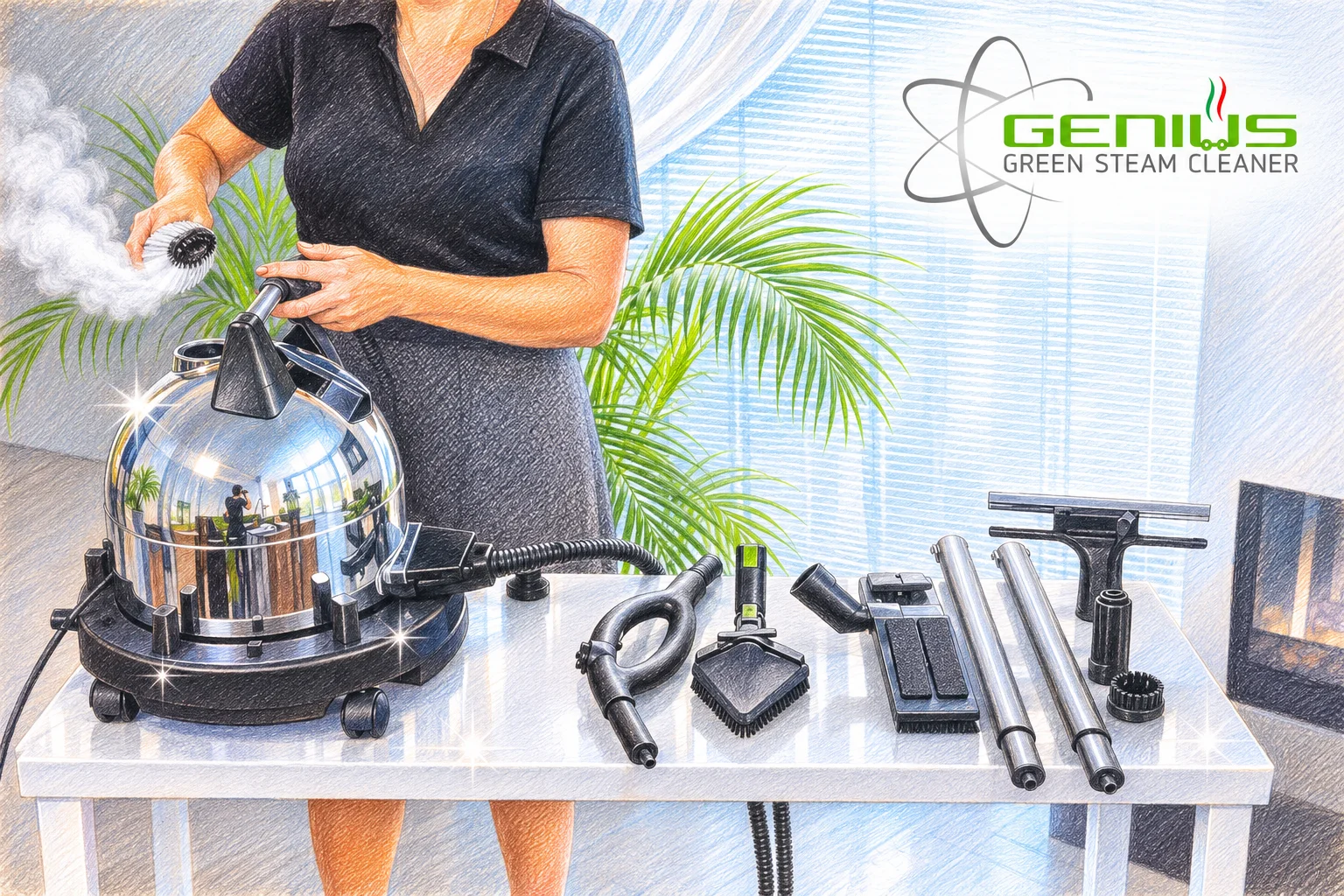
One example of this equipment available on the Israeli market is the GENIUS steam cleaning system. The manufacturer specifies a temperature of around 180 °C, pressure of up to 10 bar, and the ability to use both dry and wet steam. The system is manufactured in Italy and designed to clean various household surfaces.
But what do these specifications actually mean? Why can hot steam clean more effectively than ordinary hot water? Does it kill bacteria? Can it be used on mattresses and sofas? Can it remove limescale? And does it really make it possible to clean without household chemicals?
NAnews has prepared a detailed guide to the physics of steam cleaning, the capabilities of modern steam cleaners, and the limitations worth understanding before purchasing equipment.
How a steam cleaner works: what happens to water, steam, and dirt
Under normal conditions, water boils at approximately 100 °C. However, this figure applies at standard atmospheric pressure. Inside a sealed tank, where pressure increases, water can remain liquid at significantly higher temperatures.
This physical principle is the foundation of steam generator operation.
Water enters a heated tank, where it gradually reaches its boiling point. The steam produced creates pressure, while the heating and control system maintains the required operating conditions. When the steam valve opens, steam travels through a hose to the cleaning attachment.
GENIUS is advertised as reaching temperatures of up to 180 °C and pressure of up to 10 bar. For comparison, at an absolute pressure of 10 bar, the temperature of saturated water vapor is approximately 180 °C.
An important technical distinction is needed here. There is absolute pressure, measured relative to a vacuum, and gauge pressure, measured relative to atmospheric pressure. If the figure refers to 10 bar of gauge pressure, the saturation temperature will be approximately 184 °C.
Therefore, two figures in an advertisement do not fully describe the equipment’s operating conditions. To understand those conditions, we need to know which type of pressure is being measured and how the temperature was determined.
Furthermore, a temperature of 180 °C inside the steam generator certainly does not mean that tiles, sofas, or mattresses reach the same temperature during cleaning.
After leaving the nozzle, steam expands, mixes with the surrounding air, cools down, and begins losing thermal energy. The actual result depends on the distance from the surface, exposure time, nozzle design, and steam flow rate.
Why steam can clean better than hot water
The most interesting process occurs not when steam leaves the nozzle, but when it comes into contact with a cooler surface.
In physics, there is a concept known as the latent heat of vaporization.
Turning boiling water into steam requires additional energy. At standard atmospheric pressure, approximately 2,256 joules are needed to evaporate one gram of water at 100 °C.
When steam turns back into water, that energy is released.
Imagine a dirty kitchen tile. Hot steam reaches the tile and partially condenses, forming a thin film of water. At the same time, the dirt receives the thermal energy that was used to produce the steam.
To understand the scale, one gram of boiling water cooling from 100 to 50 °C releases approximately 209 joules of heat. By contrast, when one gram of steam at 100 °C condenses, it releases approximately 2,256 joules — more than ten times as much.
This comparison illustrates why condensation can be such an effective mechanism for transferring heat. It does not mean that every steam cleaner automatically transfers all that energy to the surface. Some heat is lost along the way, and the outcome depends on actual operating conditions.
It is this combination of heating and condensation that helps explain why steam cleaning can tackle certain types of dirt while using relatively little water.
What is the purpose of 10 bar of pressure?
Pressure serves two purposes. It allows steam to be produced at a higher temperature and ensures that it can be directed through a nozzle.
When the valve opens, the pressure difference forces steam outward. The flow passes through a narrow nozzle and acts on the selected area.
This is useful for cleaning grout lines, plumbing joints, the edges of kitchen stoves, and places that are difficult to reach with an ordinary sponge.
However, there is a common misconception that 10 bar of pressure literally blasts all the dirt out of a surface.
In reality, the pressure inside the tank is not the same as the mechanical pressure experienced by the surface being cleaned. After leaving the nozzle, the steam expands, and its speed and impact depend on the distance, nozzle shape, and amount of steam being delivered.
A higher pressure rating therefore does not automatically guarantee better results.
Sometimes, a properly selected brush combined with a moderate steam flow is more effective than the strongest possible jet.
How hot steam removes grease
When cleaning kitchen grease, temperature plays the main role.
Many fats and fatty mixtures become less viscous when heated, soften, and separate more easily from metal, glass, or ceramic surfaces.
Condensation also moistens deposits, while the directed steam flow and brush help weaken their adhesion to the surface.
However, it is important not to confuse two different processes: softening and dissolving.
Ordinary water does not mix well with most fats. Steam therefore does not transform grease into some new substance that simply disappears. Instead, it primarily makes mechanical removal easier.
After treatment, the softened grease usually needs to be collected with a cleaning cloth.
Old grease deposits that have been heated repeatedly during cooking can be particularly stubborn. Over time, some of these deposits change their structure, and steam alone may not be enough.
What is dry steam, and why does it leave less water?
The GENIUS description includes the use of both dry and wet steam.
The word “dry” does not mean that water as a substance is absent. Steam is water in its gaseous state.
In technical terms, the dryness of saturated steam depends on what proportion of the substance is in the gaseous phase and how many liquid droplets are present in the flow.
The less liquid water carried along with the steam, the drier the flow is considered to be.
This mode can be useful when cleaning surfaces where excessive moisture is undesirable. Wetter steam, on the other hand, can help soak and loosen dirt.
However, completely dry treatment is still not possible.
Even steam without suspended liquid droplets can condense when it comes into contact with a cold object, leaving moisture behind.
This is particularly important when dealing with upholstered furniture, mattresses, wooden surfaces, and materials with internal padding.
The versatility of a steam cleaning system depends not only on temperature, but also on the ability to control steam output correctly, use suitable attachments, and remove the resulting moisture promptly.
What can actually be cleaned with steam in an Israeli home?
Most homes in Israel have several areas where ordinary wet cleaning does not always produce the desired result. These include kitchens with greasy deposits, bathroom grout lines, shower screens, window tracks, and certain sections of flooring.
However, different types of dirt have different chemical properties. That is why the same steam flow may work extremely well in one situation and provide almost no benefit in another.
Tiles and grout lines
Dirt is generally relatively easy to remove from smooth ceramic tiles. Cleaning the joints between tiles is more difficult.
Tile grout, sometimes referred to as “fuga” in everyday Israeli usage, can have a rough and porous structure. Dust, soap residue, grease, and other contaminants accumulate in its small recesses.
An ordinary mop moves across the upper surface of the tiles and often has little effect on these areas.
When cleaning grout lines with steam, a narrow attachment allows the hot flow to be directed straight into the recess. Dirt becomes moist and softens, while a brush helps separate it from the underlying material.
This is one area where steam cleaning can be noticeably more convenient than conventional floor washing.
However, if the grout has already started to deteriorate, a powerful jet and stiff brush may make the damage worse.
The same applies to loose tiles and deteriorating sealants.
Ovens, extractor hoods, and kitchen stoves
In the kitchen, steam cleaning is particularly interesting because it can reduce the need for powerful degreasing products.
The hot flow softens part of the greasy layer, which can then be removed with a cloth or brush.
This is especially useful on ceramic backsplashes, suitable metal surfaces, and joints where a sticky mixture of grease and dust accumulates.
However, care is essential when cleaning household appliances.
Ovens, stoves, and extractor hoods contain electrical elements, sensors, and electronic components. Steam must not be directed into ventilation openings, electrical connections, or unprotected sections of equipment.
Furthermore, not every oven coating is designed to withstand intensive external exposure to hot steam.
The fact that temperatures inside an oven become very high during cooking does not mean that its electronic components and external connections can safely be treated with a steam generator.
Limescale on faucets and shower screens
Whitish mineral deposits on bathroom fixtures are a familiar problem for many people living in Israel.
They are associated with minerals dissolved in water, primarily calcium and magnesium compounds.
When water evaporates, some of these substances remain on the surface.
This raises an obvious question: can a steam cleaner remove limescale without chemicals?
The answer depends on the composition and thickness of the deposits.
If the buildup consists of soap scum, dirt, and a thin layer of mineral deposits, high temperatures combined with mechanical cleaning may make removal easier.
However, a dense layer of limescale, much of which consists of calcium carbonate, does not dissolve simply because it is heated with water vapor.
Suitable acidic cleaning agents are normally used to dissolve it chemically.
Therefore, it is unrealistic to expect a steam cleaning system to automatically remove years of hardened limescale from every surface.
Some materials, including marble and certain other types of natural stone, are sensitive to acids. The cleaning method must always be selected according to the surface material.
There is another problem: hard water can cause scale to accumulate inside the steam generator itself.
When purchasing equipment in Israel, it is therefore particularly important to clarify water quality requirements, tank cleaning procedures, and maintenance intervals.
Can sofas and upholstered furniture be cleaned with steam?
Upholstered furniture presents a more complicated situation than tiles.
A sofa’s surface may consist of fabric, synthetic fibers, natural materials, or a combination of these. Beneath the upholstery are padding, adhesive joints, and structural components.
Hot steam can act on surface dirt and refresh certain types of textiles that are suitable for this treatment.
But that does not mean every sofa can be steam-cleaned without restrictions.
High temperatures can sometimes damage dyes, alter fiber structure, or affect adhesive joints.
Excessive moisture can also cause internal layers to take a long time to dry.
Furthermore, an ordinary steam cleaning system does not necessarily include a function for extracting dirty liquid.
If softened dirt remains inside the fabric after treatment, the result may be worse than expected.
Before cleaning a sofa with steam, it is therefore essential to check the furniture manufacturer’s recommendations and test the method on a small, inconspicuous area.
For stubborn stains and deeply soiled upholstery, an extraction-type carpet and upholstery cleaner may sometimes be more effective.
Mattresses, dust mites, and allergens
Steam treatment of mattresses is particularly interesting to families who want to reduce the use of household chemicals and improve the hygiene of their sleeping environment.
Dust mites can live in household dust, bedding, mattresses, and other soft materials.
High temperatures can reduce their viability.
However, what matters is how deeply the material is heated.
Brief exposure of a mattress surface to hot steam does not prove that the necessary temperature has been reached inside the filling.
Another important point is that even if dust mites die, their remains and allergenic particles do not automatically disappear.
They still need to be removed using appropriate cleaning methods.
Steam treatment can therefore be an additional mattress care measure, but it is not a universal remedy for allergies.
It is particularly important to ensure complete drying, because moisture left inside a mattress can create another problem.
Does hot steam kill bacteria and viruses?
High temperatures can indeed damage proteins, cellular structures, and other components of microorganisms.
Steam treatment can therefore reduce microbial contamination under suitable conditions.
However, there is a fundamental difference between ordinary cleaning, disinfection, and sterilization.
In medical practice, steam sterilization is carried out in special devices called autoclaves. These control temperature, pressure, treatment duration, and the conditions under which steam contacts an object.
For example, sterilization procedures may use temperatures of 121 °C or 132 °C with specified exposure times.
A household steam cleaner does not become a medical sterilizer simply because the temperature inside its tank can reach 180 °C.
Effective decontamination depends on the actual temperature of the material being treated, exposure time, and the characteristics of the surface.
Claims that steam completely eliminates all bacteria, viruses, fungi, and allergens should therefore not be treated as a universal guarantee unless the testing conditions are specified.
Windows, parquet, and laminate flooring
Glass, wood, and flooring materials also behave differently under steam treatment.
On suitable glass surfaces, steam can make it easier to remove grease, fingerprints, and certain other forms of dirt.
However, rapid localized heating of cold glass creates a risk of thermal stress. Particular care is required with already damaged glass and structures sensitive to temperature changes.
Parquet and laminate flooring face another danger: the combination of high temperature and moisture.
Water can penetrate the joints between flooring elements, while heat can affect protective coatings and adhesive bonds.
Therefore, even if a steam cleaner comes with a special floor attachment, that does not mean the device is safe for every type of wooden flooring.
When preparing a kitchen for Passover, hot steam can help remove dirt from suitable surfaces, but household steam cleaning does not in itself replace the established halachic rules for kashering.
In general, when working with sensitive materials, it is best to start with the lowest permitted level of treatment and test it on an inconspicuous area.
GENIUS, a steam mop, or a wet vacuum cleaner: how the technologies differ and what to choose for your home
At first glance, most modern cleaning devices serve the same purpose: making surfaces clean.
But the physical principles behind their operation can differ significantly.
An ordinary mop removes dirt through water, friction, and the ability of the cloth to retain contaminants. If a cleaning product is used, chemical action is added to mechanical cleaning.
A steam mop uses hot steam but is primarily designed for floors in most cases.
A universal steam cleaning system such as GENIUS is intended to use different attachments for different areas of the home.
A wet vacuum cleaner works differently: it applies water or a cleaning solution and then extracts the dirty liquid.
This distinction is often more important than power ratings, pressure, or other figures used in advertising.
How a steam cleaning system differs from a wet vacuum cleaner
Consider two situations.
The first involves dirty grout lines between bathroom tiles. Here, a narrow, directed flow of hot steam is useful. It allows a specific recess to be treated and makes dirt easier to remove.
The second involves a large sofa with stains that have penetrated the upholstery. In this case, it is important not only to act on the dirt but also to extract it from the fabric along with the liquid.
A wet vacuum cleaner with an extraction function may be the better option.
A steam cleaner without suction does not automatically remove dirty liquid. It must be collected separately.
For deep cleaning of carpets, upholstered furniture, and certain textile surfaces, it therefore makes more sense to compare not only the temperature of water or steam but also the method used to remove dirt.
Combined devices offering several functions also exist, but their capabilities must be checked against the technical documentation for each specific model.
How important are temperature, pressure, and steam flow?
When choosing a steam cleaner for the home, buyers often focus primarily on the pressure rating in bar.
But that is only one parameter.
High pressure helps deliver steam, yet cleaning quality also depends on steam flow rate, temperature at the cleaning surface, and the system’s ability to maintain its operating performance during use.
For example, two devices with the same maximum pressure may deliver different amounts of steam.
One may produce a brief, intense flow, while the other may operate more steadily over a longer period.
Tank capacity, heating time, the ability to refill water, safety valve design, weight, and attachment convenience are equally important.
GENIUS belongs to the category of multifunctional steam cleaning systems. Its advertised specifications include pressure of up to 10 bar, temperatures of around 180 °C, dry and wet steam, and Italian manufacturing.
However, these specifications alone do not establish how much more effective the system is than a particular steam mop or another steam generator.
That would require comparative testing under identical conditions.
Can you really clean without household chemicals?
In many cases, yes.
If dirt can be softened by heat and removed mechanically, an additional cleaning product may not be necessary.
This advantage can be especially noticeable when treating grout lines, certain kitchen surfaces, and hard-to-reach areas.
Not using a cleaning product means that its chemical components are not left on the surface, where they might otherwise require rinsing.
But this does not make steam a universal solution.
Stubborn mineral deposits, certain types of dyes, specific chemical contaminants, and some deeply embedded stains require other methods.
Furthermore, steam itself should not be considered completely safe simply because it contains no added cleaning chemicals.
The temperature is high enough to cause serious burns. The jet must therefore never be directed at people or animals, exposed electrical contacts must not be treated, and a pressurized tank must not be opened in a manner not permitted by the manufacturer.
If children are present in the home, access to the device while it is operating must be restricted.
Another practical point: vinegar, fragrances, disinfectants, or other chemicals must not be added to the tank unless the instructions explicitly permit it.
Does steam cleaning save water and time?
Israeli GENIUS materials claim water savings of up to 80% and a reduction in cleaning time of up to 50%.
These figures sound attractive, especially when regularly cleaning a large apartment or private house.
However, evaluating them requires knowing exactly which cleaning method was used for comparison.
For example, comparing steam treatment of a small dirty area with washing the same spot using a large amount of water could reveal a significant difference in consumption.
But comparing a quick wet cleaning of an already clean floor with an ordinary mop against the full preparation and operation cycle of a steam generator would produce a different result.
The same applies to time.
Hot steam can make work noticeably easier on heavily soiled areas. However, during normal daily cleaning, it is necessary to account for preparing the equipment, heating the water, changing attachments, wiping surfaces afterward, and maintaining the system.
Without a published methodology for comparative testing, claims of 80% water savings and 50% time savings should be regarded as supplier statements rather than guaranteed results for every home.
Electricity consumption must also be considered. Heating water and producing steam require energy, and its cost becomes part of the operating expenses.
What to check before buying GENIUS in Israel
The most reliable way to evaluate a steam cleaning system is to see how it performs on real dirt.
For example, choose an area of the kitchen with old grease, a darkened grout line in the bathroom, or a joint between floor tiles that is difficult to clean with an ordinary brush.
It is important to assess not only the condition of the surface immediately after treatment, but also how much dirt remains, whether additional wiping is necessary, and what the result looks like after everything has dried completely.
If the task involves furniture or a mattress, the permitted materials and the method of moisture removal should be clarified separately.
It is also worth asking the seller what pressure the system maintains during actual operation, how much steam it delivers, whether steam moisture can be adjusted, how much electricity it consumes, and which attachments are included.
For Israeli conditions, particularly important considerations include water quality requirements, descaling procedures, service availability, warranty coverage, and the ability to purchase replacement parts.
GENIUS offers in-home equipment demonstrations. You can find out about the availability of home visits, conditions, and included equipment on the Israeli GENIUS website.
NAnews previously published an article about preparing a large family home in Israel for Shabbat and holidays, in which Elena Gunko discussed the possibilities of steam cleaning, the technology’s limitations, and the organization of home demonstrations with a GENIUS representative.
So what is better for the home: a steam cleaner, an ordinary mop, or a wet vacuum cleaner?
There is no single answer, because these devices perform somewhat different tasks.
A vacuum cleaner is still needed for everyday removal of dust and sand. An ordinary mop is often sufficient for quickly washing a relatively clean floor. An extraction cleaner is useful for deep cleaning carpets and sofas while removing dirty liquid.
A steam cleaning system is particularly useful where directed heat is needed: for removing certain greasy deposits, cleaning grout lines, and treating suitable kitchen and bathroom surfaces.
In Israeli homes with extensive ceramic tiling and areas that are difficult to clean manually, these capabilities can have practical value.
However, it makes more sense to choose equipment based not on the maximum temperature printed in an advertisement, but on how well it handles specific cleaning tasks.
The GENIUS system uses well-known physical processes: the production of hot steam, increased pressure, heat transfer through condensation, the softening of dirt, and its mechanical removal.
There is no special chemical reaction that makes dirt disappear without a trace.
This is both the technology’s main advantage and its main limitation. Ordinary water becomes an effective cleaning tool through the controlled use of heat and pressure, but some contaminants and materials still require other methods.
A good steam cleaner is therefore not a replacement for every other cleaning tool. It is a separate device that can make certain jobs faster, more convenient, and less dependent on cleaning chemicals.
Ultimately, the best way to determine whether a particular family needs such a device is not through advertising, but by testing how it performs in their own home.
GENIUS offers in-home equipment demonstrations. You can find out about the availability of home visits, conditions, and included equipment on the Israeli GENIUS website.