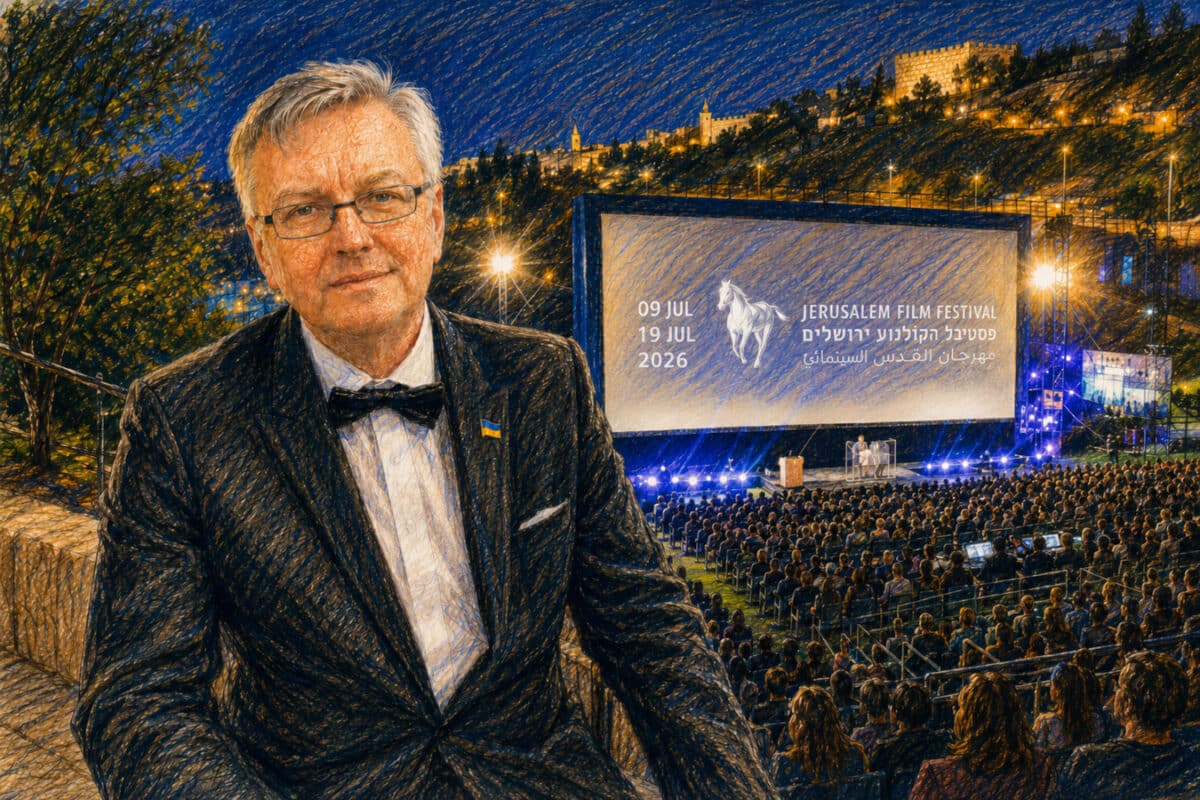
Ukrainian director Sergei Loznitsa, one of the most prominent authors of contemporary European cinema, will be an honorary guest at the Jerusalem Film Festival 2026.
He will participate in the opening ceremony, receive a special recognition award from the festival, and head the jury of the Israeli competition.
For Israel, this event goes beyond the usual film schedule. A director whose films have been shown at major European festivals for many years is coming to Jerusalem, and his work on themes of memory, war, violence, archives, and human responsibility is well understood by the Israeli audience.
In 2026, the Jerusalem Film Festival will take place from July 9 to 19. This will be the 43rd edition of Israel’s main international film forum.
Loznitsa in Jerusalem: why it matters
Sergei Loznitsa was born in 1964, grew up in Ukraine, and became one of the most renowned directors working at the intersection of documentary, archival, and feature films.
His films have been shown in Cannes, Venice, Berlin, Karlovy Vary, and other major international venues.
For the Jerusalem Film Festival, Loznitsa is not a new figure. Several of his films have already been shown here, and works like “Invasion” and “Babi Yar. Context” have received festival recognition.
For Israel, this is a particularly sensitive topic: the film about Babi Yar is connected not only with Ukrainian history but also with Jewish memory, the Holocaust, societal responsibility, and how cinema can speak about tragedy without simplification.
Now Loznitsa returns to Jerusalem not just as a program participant. He will become an honorary guest of the festival and the chairman of the jury of the Israeli competition.
This means that he will be evaluating films created in Israel and speaking to the Israeli reality from within.
At a time when Israeli culture faces pressure on international platforms, the presence of authors of such caliber in Jerusalem becomes an important signal. Israeli cinema continues to be part of the global cultural scene, and the festival in Jerusalem remains a place where directors, producers, curators, and critics from different countries come.
When and where the festival will take place
The 43rd Jerusalem Film Festival will take place from July 9 to 19, 2026 – https://jff.org.il/.
The opening ceremony will be held at the Sultan’s Pool — one of Jerusalem’s most recognizable open venues. It is there that the festival traditionally gathers a large audience, guests, industry representatives, and program participants.
The opening film will be Tell Me Everything by Israeli director Moshe Rosenthal. The screening is scheduled for July 9 at 8:00 PM and will take place in the presence of the creators and actors.
The main festival venues are Jerusalem Cinematheque, Lev Smadar, Yes Planet, as well as special city spaces.
This is not just one hall or a series of separate premieres, but a large city festival that turns Jerusalem into the center of Israeli and international cinema for ten days.
For readers of NAnovosti — News of Israel, this story is also important because it shows that Israel’s cultural life does not stop even in the most challenging periods.
Jerusalem not only hosts films but also shapes the conversation about how cinema can speak about war, memory, society, freedom of speech, and the future of the country.
Who participates and what will be in the program
According to organizers and Israeli media, more than 25 international guests will attend the festival in 2026.
Among them are directors, producers, actors, festival curators, and industry representatives from Germany, France, Switzerland, Argentina, the USA, and other countries.
Among the participants and jury members mentioned are Corinna Harfouch, Angela Schanelec, Mar del Plata Film Festival director Jorge Stamadianos, French producer and critic Hélène Schumann, and American film curator Alissa Simon.
On the Israeli side, the jury includes Roni Aboulafia, Nir Bergman, and Yona Rozenkier.
The festival program includes an international competition, Israeli feature films, documentaries, short films, debuts, special screenings, classics, experimental works, and separate thematic sections.
The directions announced include International Competition, Masters, Gala, Panorama, Debuts, Spirit of Freedom, On the Radar, JFF Classics, as well as programs of Israeli feature, documentary, and short films.
The Israeli part of the program holds a special place. The festival showcases new works by local directors, provides a platform for documentarians, supports short films, and helps films reach a professional international audience.
For authors, this is an opportunity to present their projects not only to viewers but also to producers, funds, critics, and festival selectors.
The program will also include films already noted at major international festivals. The Jerusalem Film Festival traditionally gathers works that have previously passed through Cannes, Berlin, San Sebastian, Toronto, Rotterdam, Tribeca, SXSW, and other important venues.
Industry, pitches, and the conversation about the future of Israeli cinema
From July 9 to 12, industry days will be held as part of the festival. This is the professional part of the program where new projects, funding, international cooperation, editing, film promotion, and the state of the film industry are discussed.
One of the central events will be Pitch Point, which in 2026 will be held for the 18th time. This is a platform for feature-length projects in production or editing stages.
Prizes and editing grants totaling 100,000 shekels are provided for participants.
Pitch Point Shorts will be held separately in collaboration with the Gesher Multicultural Film Fund. In this program, seven independent short film projects will compete for a grant of 250,000 shekels.
There will also be student pitches, documentary initiatives, professional meetings, and the YerushalAim competition dedicated to creating films using artificial intelligence tools.
This shows that the festival is not limited to screenings of finished films. It works as a full-fledged platform for future cinema — from idea and script to editing, funding, and reaching the audience.
Special attention will be given to discussions about the state of Israeli cinema after October 7. The program includes conversations about freedom of speech, joint creativity of Jews and Arabs, pressure on authors, cancellations, international reactions, and the future of the local industry.
One of the final events will be the discussion “Who will save my film?”, where directors, producers, funds, and professional associations will talk about how Israeli cinema can survive and develop in a new reality.
That is why NAnovosti — News of Israel considers this festival not only as a cultural event but also as an important public conversation.
In Jerusalem, they will talk not only about films but also about Israel’s place in the world, the right of Israeli authors to be heard, and how culture responds to trauma, war, and political pressure.
History of the Jerusalem Film Festival
The Jerusalem Film Festival began on May 17, 1984.
The first film was Le Bal by director Ettore Scola. The first festival lasted about three weeks, showing approximately 100 films, including Israeli premieres and important international films of the year.
Among the guests of the first festival were Lillian Gish, Jeanne Moreau, Warren Beatty, and John Schlesinger.
Even then, it was clear that Jerusalem was aiming not for a local event for a narrow circle of viewers but for a full-fledged international film forum.
A key role in the creation of the festival was played by Lia van Leer — the founder of the Jerusalem Cinematheque, the Israel Film Archive, and one of the most important figures in the history of Israeli cinematic culture.
Thanks to her work, an institution appeared in Jerusalem that combined an archive, an educational space, a festival, and a professional platform for authors.
Over the decades, the festival has become Israel’s main film forum. Today it lasts about ten days, shows hundreds of films in competitive and non-competitive programs, opens new names, returns classics to the big screen, and helps Israeli cinema remain part of the international conversation.
Why this event goes beyond the film schedule
The arrival of Sergei Loznitsa in Israel is important in several ways.
Firstly, it is the participation of a European-level director whose filmography is associated with themes of historical memory, documentary testimony, violence, and moral responsibility. For the festival, this enhances the international status of the program.
Secondly, Loznitsa will work specifically with the Israeli competition. This means that attention will be directed not only to him as a guest but also to the Israeli films he will evaluate along with other jury members.
Thirdly, the festival takes place at a time when Israeli culture needs a professional, honest, and open conversation with the world.
The Jerusalem Film Festival provides such a platform — not with slogans, but with a program, guests, premieres, discussions, and meetings.
In this sense, the 43rd Jerusalem Film Festival becomes not just a summer cultural event. It shows that Israel continues to speak to the world in the language of cinema, memory, art, and human experience.
And the arrival of Ukrainian director Sergei Loznitsa makes this story particularly notable: an author whose cinema has long dealt with themes that are all too familiar to both Ukraine and Israel is coming to Jerusalem.