
Achilles tendon pain rarely appears suddenly. In most cases, it starts as mild discomfort after walking, running, or spending long hours on your feet. At first, the pain may feel insignificant and disappear after rest. Over time, however, it tends to return more often, becoming sharper in the morning and more noticeable by the end of the day. Many people describe stiffness during the first steps after getting out of bed, followed by persistent tension along the back of the lower leg.
The Achilles tendon is one of the strongest tendons in the human body, yet it is constantly exposed to mechanical load. Walking, climbing stairs, standing at work, and physical activity all place repeated stress on this structure. When the tendon does not have enough time or resources to recover, pain may gradually become chronic and begin to affect daily life.
At this stage, patients often start looking for structured, non-invasive treatment options. Many turn to the Russian-language version of the clinic’s website
https://uvt.nikk.co.il/
to understand how chronic tendon pain is approached without injections or surgery.
At the same time, patients frequently consult English-language sources to compare treatment principles and medical explanations. For this purpose, the English version of the clinic website
https://uvt.nikk.co.il/en/
provides detailed information about shockwave therapy and its application in musculoskeletal conditions.
Why Achilles tendon pain tends to persist
One of the main reasons Achilles tendon pain becomes long-lasting is limited blood supply to the tendon tissue. Compared to muscles, tendons receive less circulation, which means micro-injuries heal more slowly. Repetitive strain leads to accumulation of microscopic damage, reduced elasticity, and localized inflammation.
As pain develops, many patients unconsciously change the way they walk to avoid discomfort. This altered gait may temporarily reduce pain in the tendon but often creates additional stress on the knee or foot. In clinical practice, Achilles tendon pain is frequently associated with knee discomfort caused by altered biomechanics. This relationship is discussed in more detail here:
https://uvt.nikk.co.il/bol-v-kolene/
(Page in Russian)
How ESWT is used for Achilles tendon pain
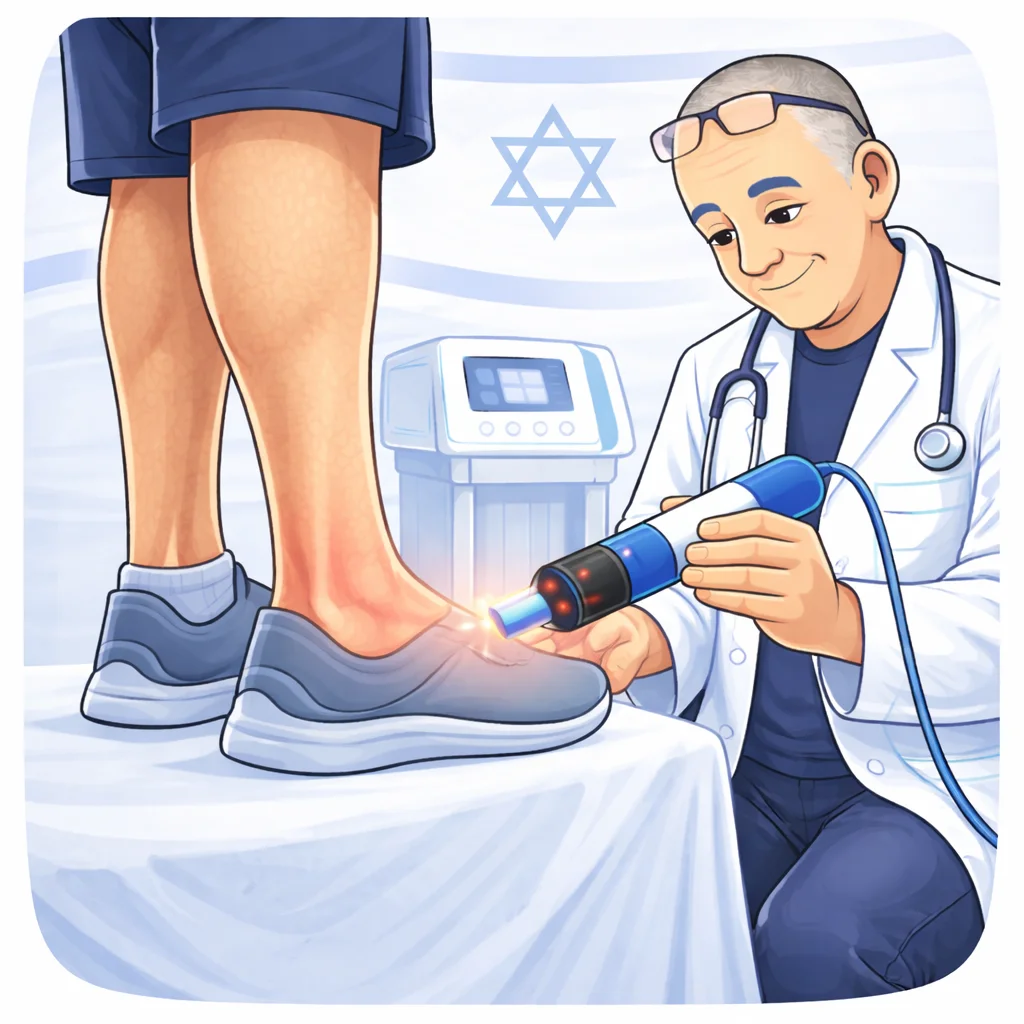
Extracorporeal Shockwave Therapy (ESWT) is applied as a method of mechanical stimulation using acoustic waves directed at the affected area. These waves do not damage the tendon. Instead, they stimulate local circulation and support biological repair processes within the tissue.
For Achilles tendon conditions, ESWT is aimed at:
- improving microcirculation in the tendon area
- reducing chronic inflammatory response
- decreasing pain sensitivity
- supporting tissue regeneration
Unlike pain medication, ESWT does not mask symptoms. Its purpose is to create conditions that allow the tendon to recover more effectively over time.
For patients who want a deeper understanding of the anatomy and treatment principles, additional information is available in this English-language resource:
https://uvt.nikk.co.il/en/achilles-tendon/
What patients usually experience during treatment
During an ESWT session, patients feel localized mechanical stimulation along the Achilles tendon. Sensations vary depending on sensitivity and the condition of the tissue, but most patients find the procedure tolerable without anesthesia.
After a session, temporary soreness or increased sensitivity may occur. This reaction is expected and usually resolves within a short period. Improvement typically develops gradually rather than immediately. Patients often report reduced morning stiffness first, followed by improved comfort during walking and daily activity.
When ESWT may be considered
Shockwave therapy for Achilles tendon pain is commonly discussed when:
- pain lasts for several weeks or months
- discomfort increases with walking or physical load
- morning stiffness becomes a regular issue
- rest and topical treatments provide only short-term relief
Early evaluation and proper intervention may help prevent further limitations in mobility.
Treatment availability in Israel
The David Sendler Pain Treatment Clinic provides ESWT services in multiple regions across Israel, allowing patients to receive care without extensive travel.
Appointments are available in:
Haifa, Krayot, Akko, Nahariya, Afula, Yokneam, Petah Tikva, Netanya, Hadera, Kfar Saba. Israel.
A home visit for treatment demonstration is available by prior arrangement, which can be helpful for patients with limited mobility or significant pain.
Clinic hours and contact
Clinic operating hours are:
Sunday–Thursday: 10:00–19:00
Friday and pre-holiday days: 9:00–14:00
Saturday: closed
Online contact through the clinic website is available 24/7.
Use of the website and data processing are governed by the clinic’s privacy policy:
https://uvt.nikk.co.il/privacy-policy/
Why patients choose a non-invasive approach
Many patients prefer to avoid injections, surgery, or long-term medication whenever possible. ESWT is often viewed as a balanced option that supports tissue recovery without aggressive intervention. The method is widely used for tendon-related pain where gradual improvement and functional recovery are key goals.
Conclusion
Achilles tendon pain should not be dismissed as a normal consequence of activity or aging. Persistent discomfort is a sign that the tissue requires support to recover properly. Modern non-invasive methods such as extracorporeal shockwave therapy provide a way to address the underlying problem rather than simply suppress symptoms.
With timely evaluation and an appropriate treatment approach, restoring comfortable movement and confidence while walking becomes a realistic objective rather than an uncertain hope.